
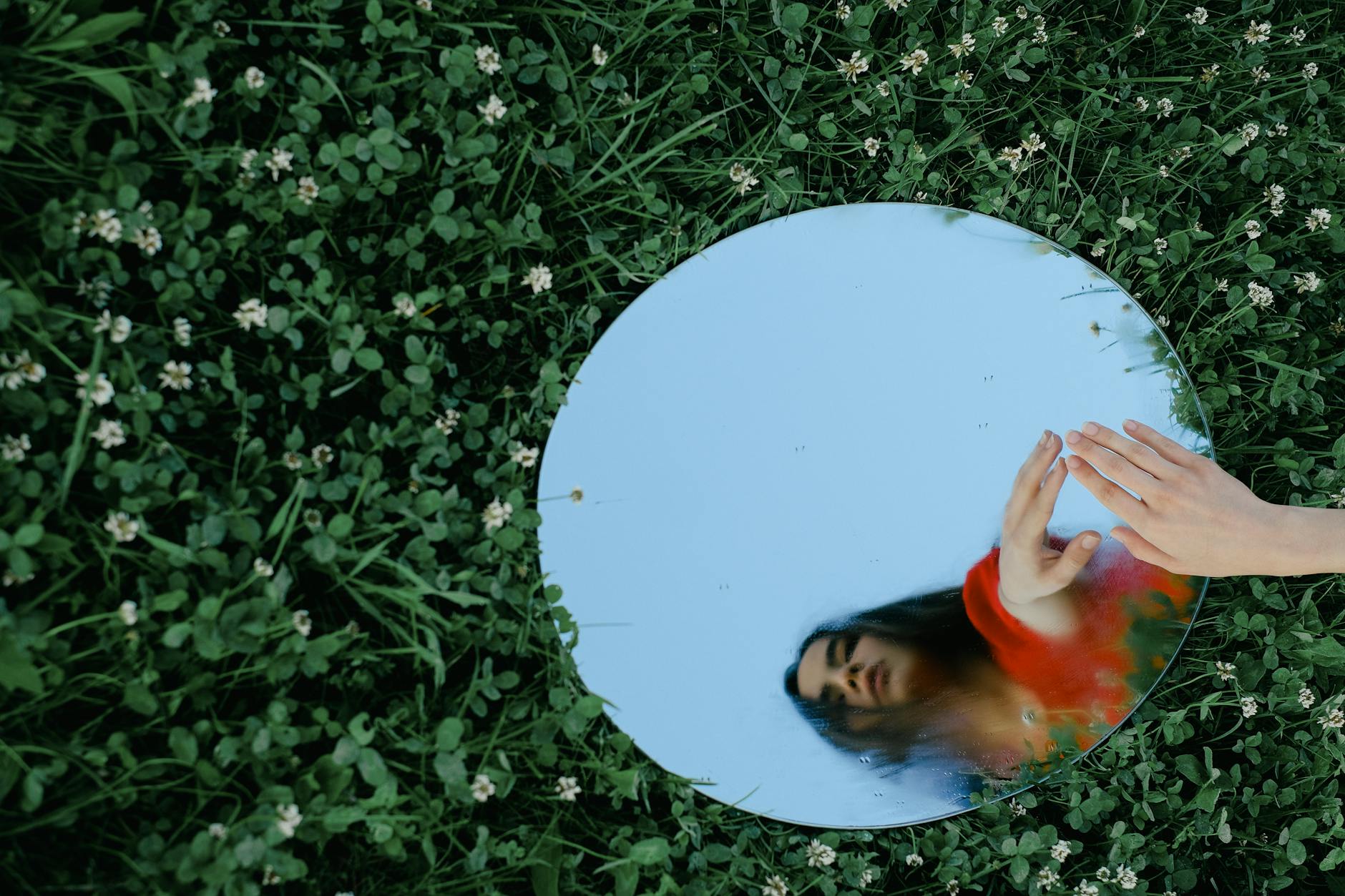
‘The world will ask you who you are and if you do not know, the world will tell you.’
Carl Jung
We all share a narrative to the world about our identity or the identity which we believe is expected of us.
Nevertheless, for me, the path to reveal my authentic truth, may live gently inside the ‘not knowing’ and understanding ‘Who I am not.’
I heard a story the other day about a study they did with a group of people to monitor and expose Perception Bias.
The “Scar on the Face” study, formally known as the Dartmouth Scar Experiment conducted by psychologists Robert Kleck and Angelo Strenta in 1980, is a landmark study in social psychology that demonstrated how expectancy bias shapes our perception of reality.
Perception Bias is the subconscious distortion of our reality and who we believe we are, or need to be, in order to be loved and accepted.
It reveals and interprets information based on the stereotypes, beliefs, or personal experiences we have learned growing up, and how it affects our judgement.
In this particular study, a make-up artist placed a disfiguring scar on each of the participant’s faces, which went from the ear down to their mouth. The participants felt quite overwhelmed when they saw the scar in the mirror, and then they were asked to socialize with a group of strangers.
When they returned, all the participants reported a high level of social discomfort, anxiety, and judgement which they said they felt by the people they met.
However, just before the participants went out to socialise, the make-up artist told them she was applying moisturiser to secure the scar, but instead she wiped off the scar completely, unknowingly to them.
This experiment really highlights how powerful our internal thoughts and our self-consciousness perceptions are as we move out into the world each day.
And so, in conclusion I asked myself, ‘What scars am I carrying unconsciously, and how is this separating me from connection, stability, and the fullness of all life?
May we all release the stories that hold us back from being the brightest versions of ourselves! 🌈


This is a fascinating study, Karen! It’s such a simple and creative way to help people see the power of their thoughts and beliefs! 🤗💜
I have never heard about this 1980 study before even though I have long realized how the lenses researchers (and others) look through significantly affect what they see. Or, as a Sufi story that seems to have been removed from the internet points out, “you will only learn what you already know.” Biases are powerful and often invisible, and they matter a lot for researchers, especially those who believe “objectivity” is possible.
“Doing research is, in many ways, like taking a descriptive and explanatory snapshot of empirical reality. For each particular photograph, the investigator must decide what kind of camera to use, what scene on which to focus, through which filter, and with what intent.” ( Benjamin F. Crabtree and William L Miller, eds., Doing Qualitative Research, 2nd ed. (Thousand Oaks, CA: Sage Publications, Inc., 1999), 3.)
It’s helped me be aware of the lenses I look through and be honest with readers about the person behind what I say. They have a right to information about authors that will help them assess the trustworthiness of what they read. It’s something that’s increasingly difficult to figure out these days!
Thank you for sharing such a fascinating topic in such a thought-provoking post!
I love the Sufi quote you mention, ‘You will only learn what you already know.’ It’s so true. I’m grateful for the people who take the time to study, investigate, and gather the wisdom and information we need to break the illusions we are fed each day. And yes it is increasingly difficult to figure out these days.
Thank you Carol for the work you have done and continue to do, and for your contribution to the beautiful tapestry of life. 🧡🌈🙏🏻
Thank you for the wisdom and kindness you continue to share, dear Karen. 💜🪶🌻
You always present the most thought provoking and interesting posts, Karen to where I learn something new. I find Carl Jung’s quote to be so true in my life. Perception Bias I think is something many of us have experienced. It’s taken me my whole life to figure out who I am and who I’m not. But even though most of my life I was lost, I’m so glad I’m figuring things out and realize it’s an ongoing process that won’t end until I am no more. What’s interesting is that as I’m figuring me out, I am helping others (I hope) along the figuring out trail too. Thank you for another great post.
Thank you Michele. It’s so true. We will continue to unfold the layers of illusion and truth until we are ‘no more’ and I do believe as we reveal this together, we are helping each other grow, heal, and be seen in our true light. I appreciate your comment 🙏🏻💜🌈
Maybe that’s why we’re here.
I absolutely believe that 🧡🌈
This is a powerful post Karen. This life does embroil us in so many ‘ways, concepts and expectations’ to which we hold…and gradually, finally, realise they hold no import at all.
But, they teach us ‘us’ in doing so. It took me a long time but finally I loved the one person I ever doubted. And only then could I truly love another when I finally experienced it and understood. And yes, we wear so many scars, but do gradually wipe them off. Great share kind lady, thank you 🤗❤️🙏
You are right Mark, when we finally love ourselves as we are in this moment, there is room for Grace, and to see and receive the love in another. Thank you for being here. 🧡🌈🧡
So true Karen, our identity is not determined by the world, this is why it is so important that we know who we really are, but sadly we do not find this out till after much pain and struggle from within and from allowing others along the way influence and judge us. As a believer in Jesus I get my identity from him as a very loved and valued child of God. The opening comment is so true, if we do not know who we are the world will quickly put their spin on us, and as you say our perception of ourselves from the world will influence how emotional, mental, social and even to some extent our physical development as a person. To be truly differentiated is to be able to know and accept oneself to enable and utilize our individual quaintness and individual ADHD or OCD or whatever our spectrum position may be to be a blessing and make us winners in life as I have learned to be and help others realise. Your posts are always inspiring and helpful raising important issues of life from a wise and insightful perspective. Richest blessings my friend.
Thanks Ash, it’s true, all our experiences and learnings throughout life become the accumulation of our wisdom and our inner knowing.
Accepting everything that arises as you say can be a blessing and always creates new perspectives to move forward. Thank you. 🙏🏻🌈
Loved the opening quote by Jung, Karen, and you followed it with a powerful reminder of how much of our “reality” is shaped from the inside out. This is the first I’ve heard of the scar experiment, and it beautifully shows how self-judgments can keep us from real connection… a great thought to ponder this Sunday morning. Thank you! 🌈
I agree Randall, because we all seek a real connection with one another, it makes sense to question why we feel separated or judged by each other. Thank you as always for your thoughtful presence here. Have a great week ahead 🌈🧡🙏🏻
What a powerful study! Thanks for sharing it, Karen. A question very worthy of consideration. 💕
Yes I agree. I loved the results of this study. Thanks so much Eliza 🧡🌈🧡
Karen,
What a fascinating study. It makes me wonder how much of what I continue to experience comes from the person I see myself to be. I like your question, “What scars am I carrying unconsciously, and how is this separating me from connection, stability, and the fullness of all life?” I will ponder this. Maybe it will return as some kind of poem.
Thank you for sharing wisdom.
Wishing you peace,
Ali
I agree Ali, observing ‘who I think’ I am versus the expanse of ‘who I am’ is so important. Thank you so much. I look forward to reading this as one of your poems too!
🧡🌸🧡
Another thought-provoking post Karen! It brought to mind a post that I wrote titled “The Two of Us” (9/13/21). And it referred not to two people but rather one in the same. Following is an excerpt quote from it:
“When one looks in a mirror he sees an ever-changing exterior. What I saw as a child I see not as an adult. Have you ever heard one, who you haven’t seen in a while, tell you that you haven’t changed; that you’re still the same? By what you see in the mirror you know that not to be true. But maybe it is. Is what they see the me or the I?”
-Alan
I like the sound of the post you wrote Alan. I also like the question you have at the end, and yes, to say we have not changed is never true.
Life itself is constantly moving, changing, and evolving and I believe that when we do change for the better, it’s simply because we are revealing or allowing more or the ‘I’ our authentic true nature, (which is always whole)
to be seen and shared with others. Thank you Alan 🌈🧡🙏🏻
You’re very welcome, Karen and thanks.
-Alan
🙏🏻🌈